Graduate Project Developed in Foundations of Program Evaluation, AU:
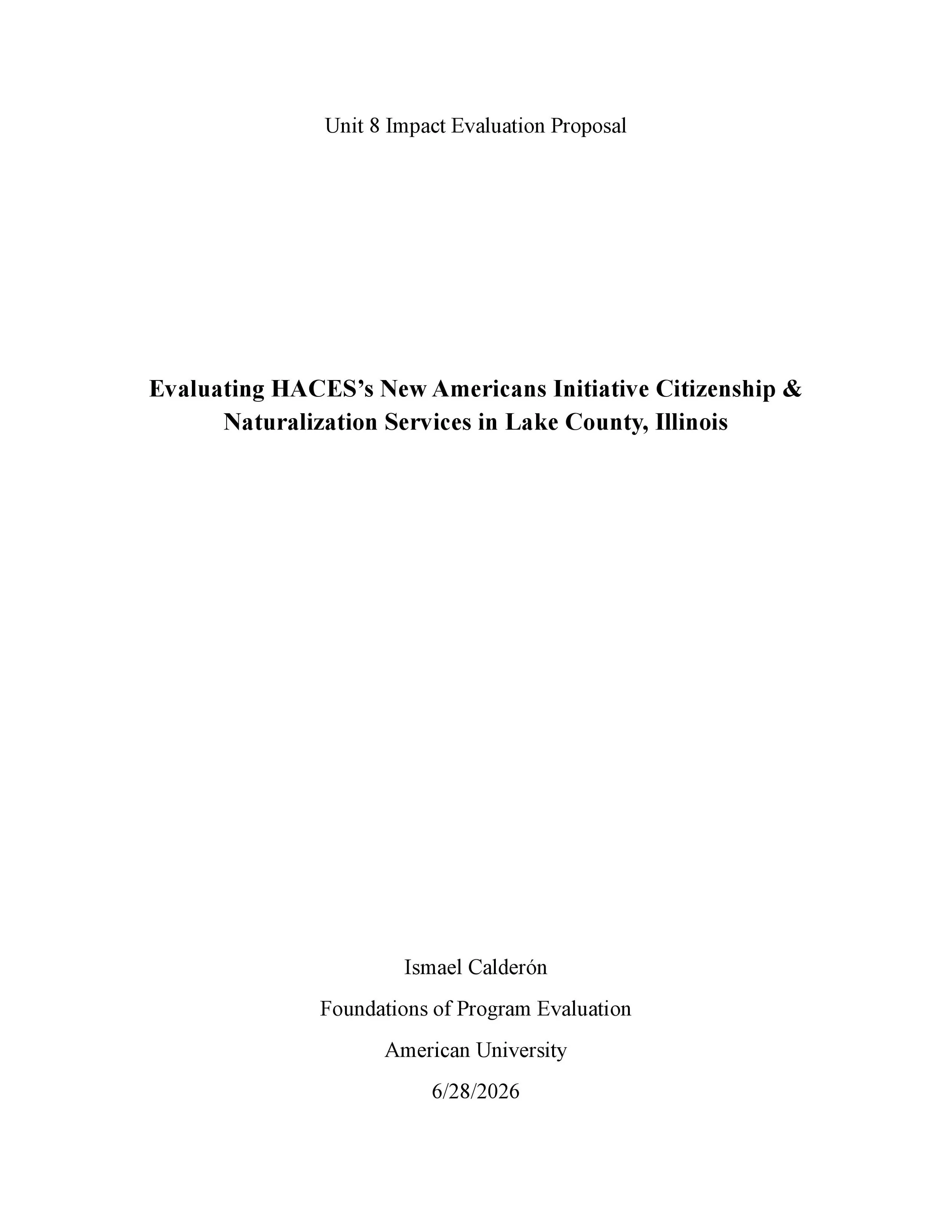
Designing a quasi-experimental evaluation to assess whether citizenship and naturalization services increase naturalization outcomes for eligible lawful permanent residents in Lake County, Illinois.
Impact Evaluation Design for HACES’s New Americans Initiative:
Metrics
12-Month Evaluation Period:
January 1–December 31, 2027.
1 Primary Outcome:
Naturalized by December 31, 2027.
6 Milestone Outcomes:
N-400 submission, USCIS receipt, biometrics, interview completion, interview passage, and oath ceremony completion.
Quasi-Experimental Design:
Pretest-posttest design with a matched comparison group.
Final Products:
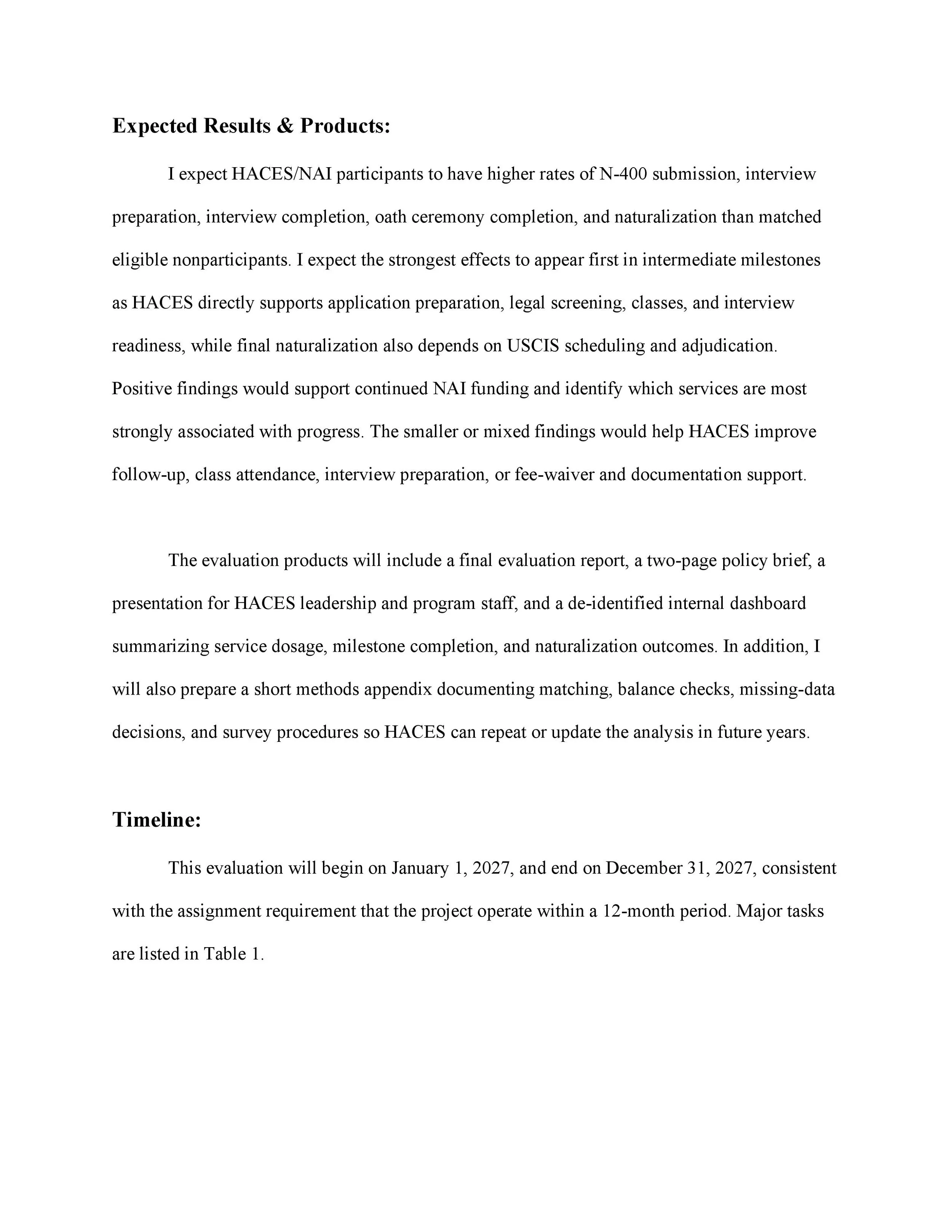
Evaluation report, two-page policy brief, presentation, dashboard, and methods appendix.
Overview
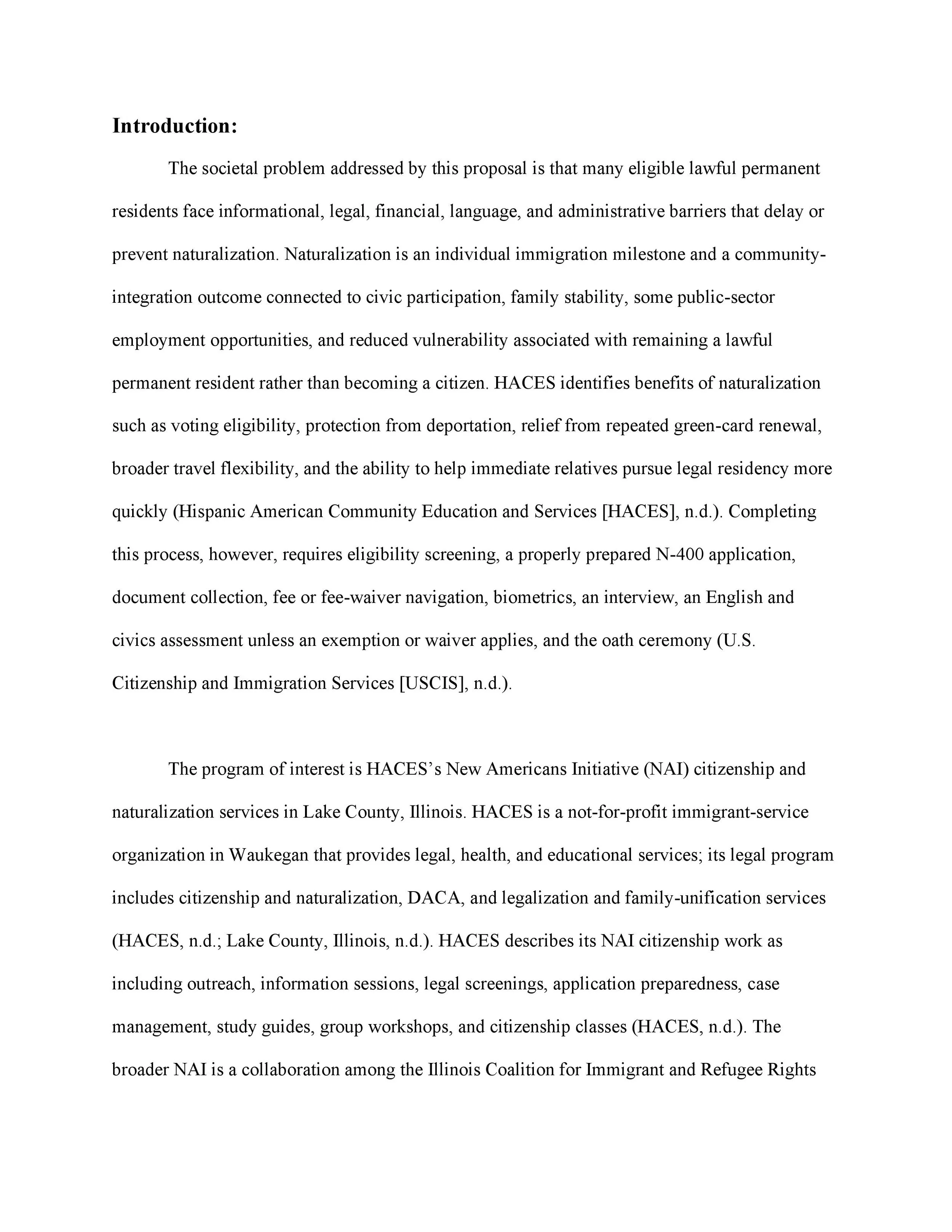
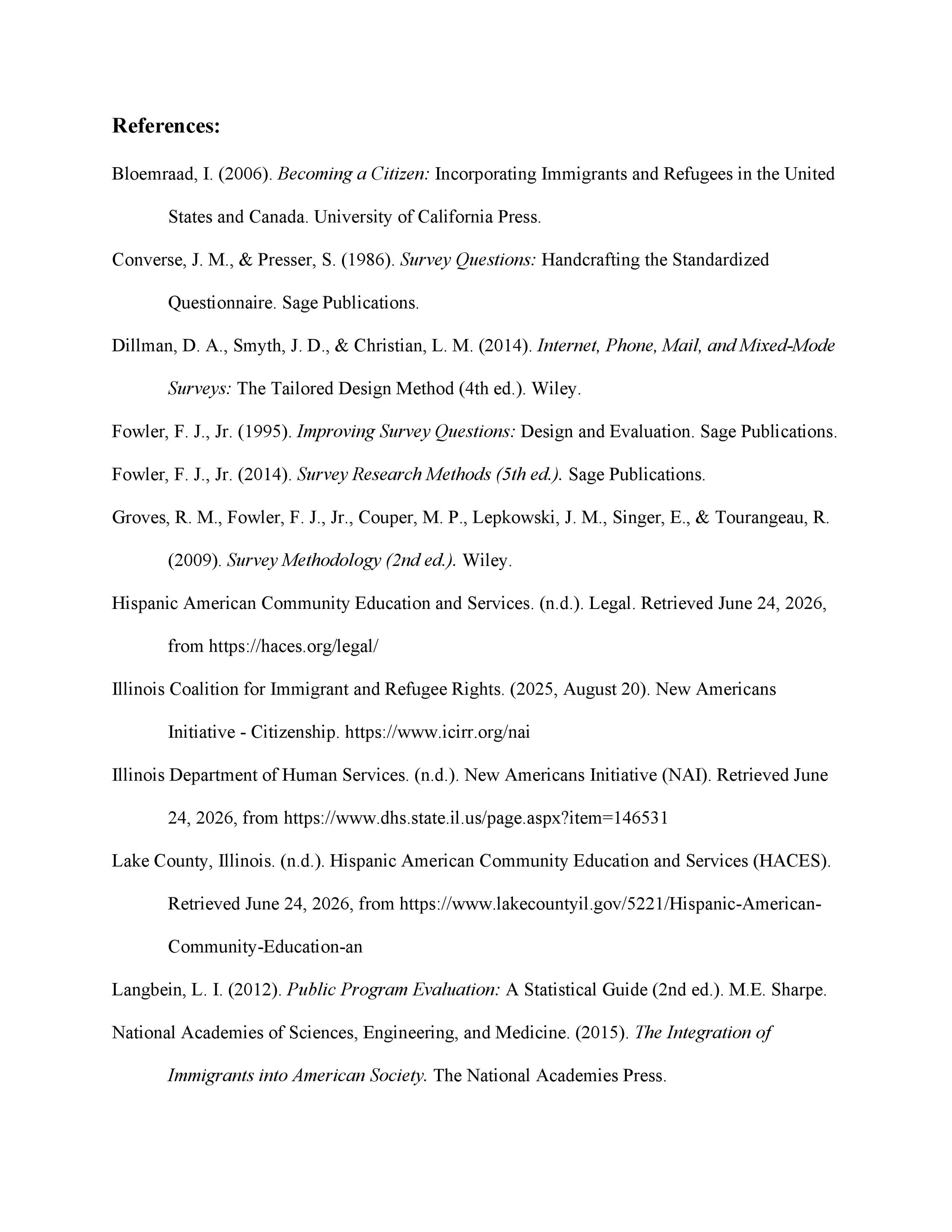
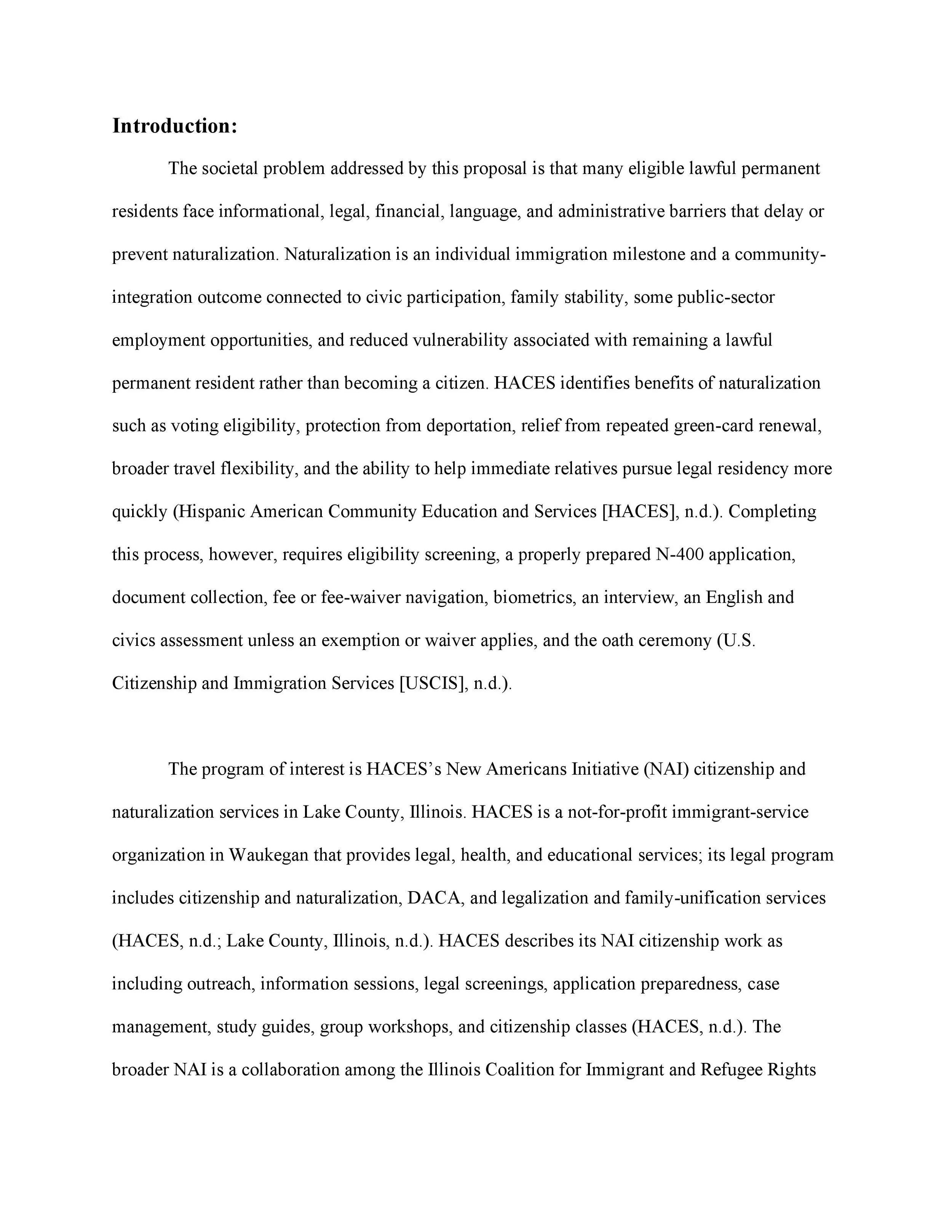
This project developed an impact evaluation proposal for HACES’s New Americans Initiative citizenship and naturalization services in Lake County, Illinois. The proposal focused on a practical public-service question: whether participation in HACES/NAI services increases the likelihood that eligible lawful permanent residents become naturalized U.S. citizens and complete key intermediate milestones in the naturalization process.
The Evaluation Problem
The proposal begins from the recognition that many eligible lawful permanent residents face informational, legal, financial, language, and administrative barriers that can delay or prevent naturalization. Naturalization is framed not only as an individual immigration milestone, but also as a community-integration outcome connected to civic participation, family stability, employment opportunity, and reduced vulnerability.
Program Theory
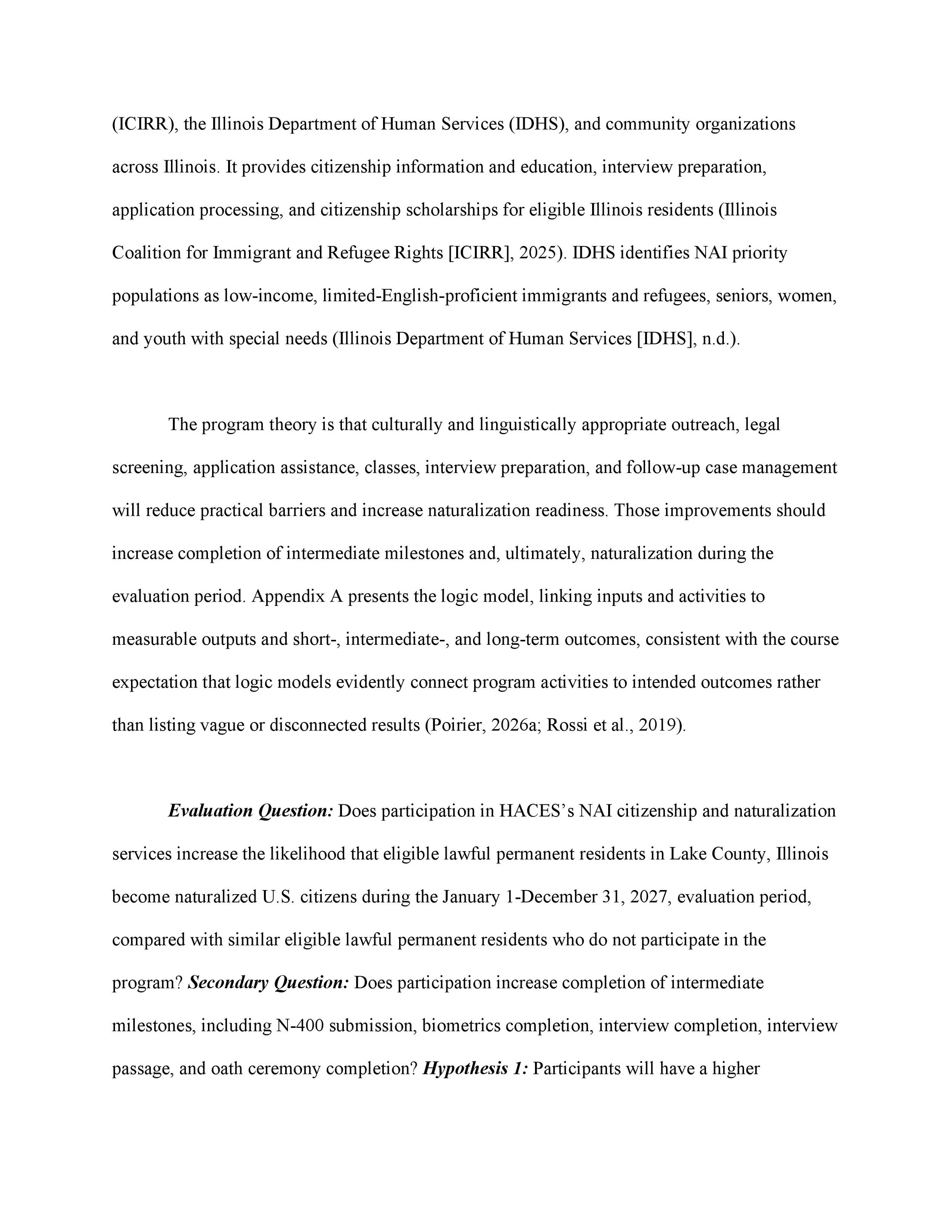
The program theory was that culturally and linguistically appropriate outreach, legal screening, application assistance, citizenship classes, interview preparation, and follow-up case management would reduce practical barriers, increase naturalization readiness, improve milestone completion, and ultimately increase naturalization rates among eligible lawful permanent residents served by HACES/NAI.
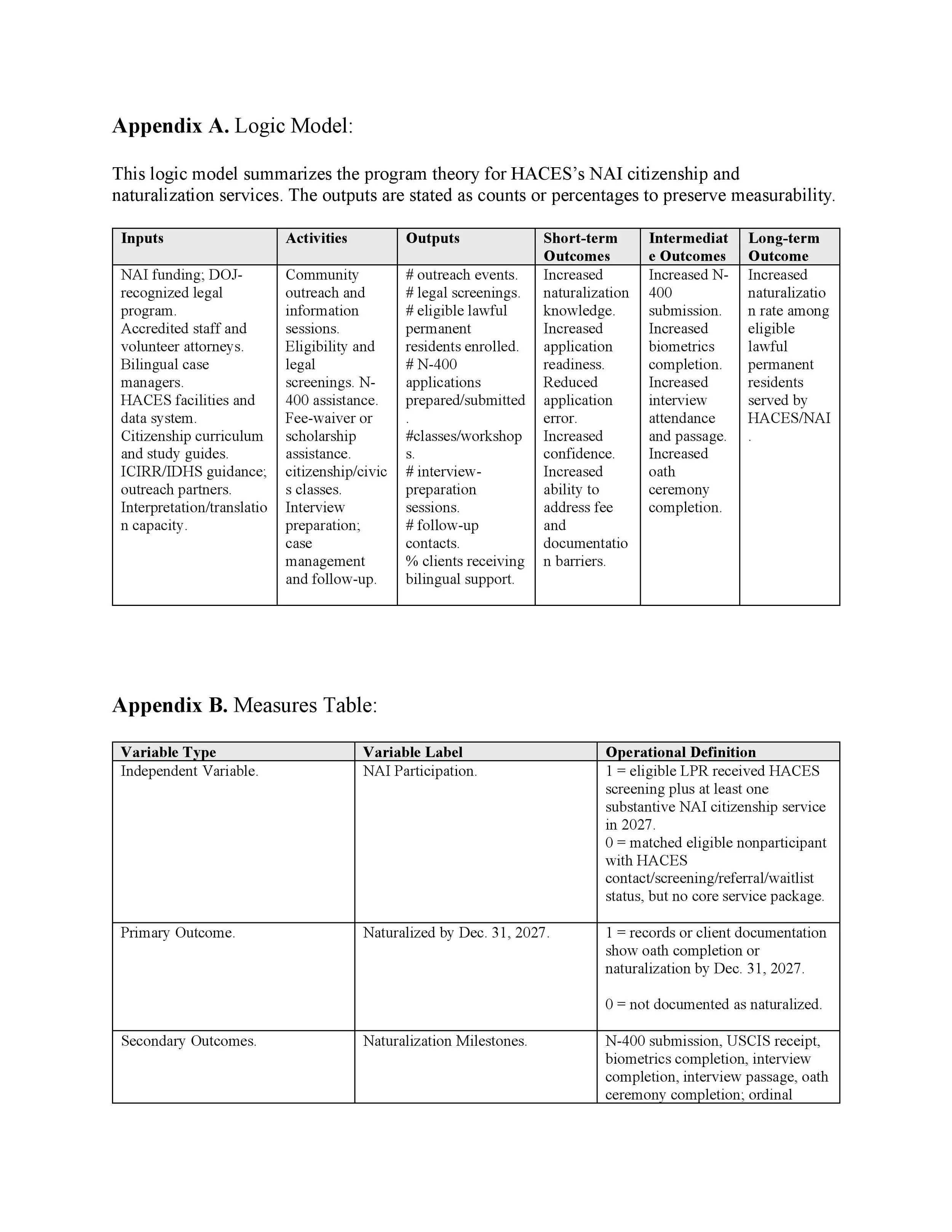
The logic model connected inputs such as NAI funding, accredited staff, bilingual case managers, HACES facilities, interpretation capacity, and outreach partners to activities, measurable outputs, short-term outcomes, intermediate milestones, and the long-term outcome of increased naturalization.
Evaluation Design
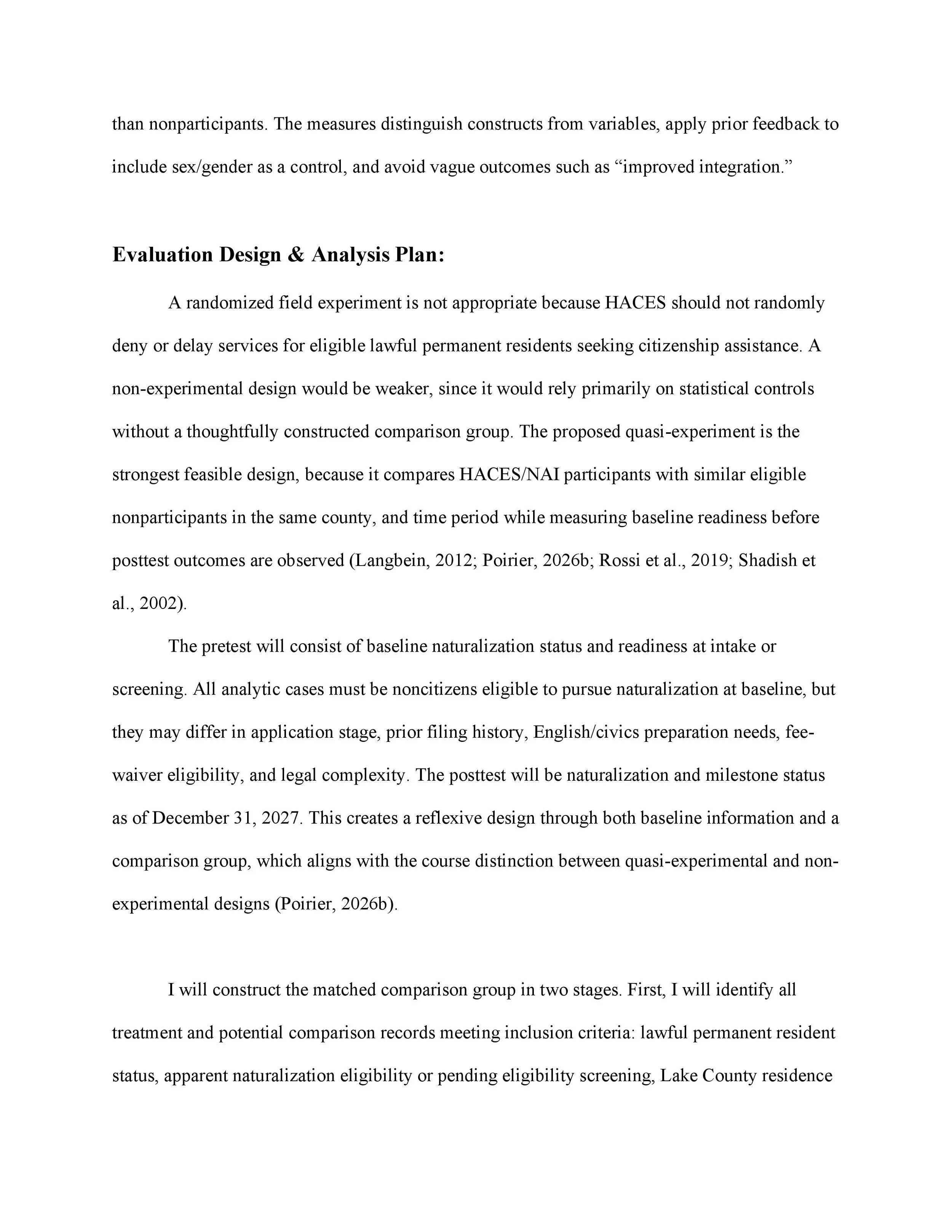
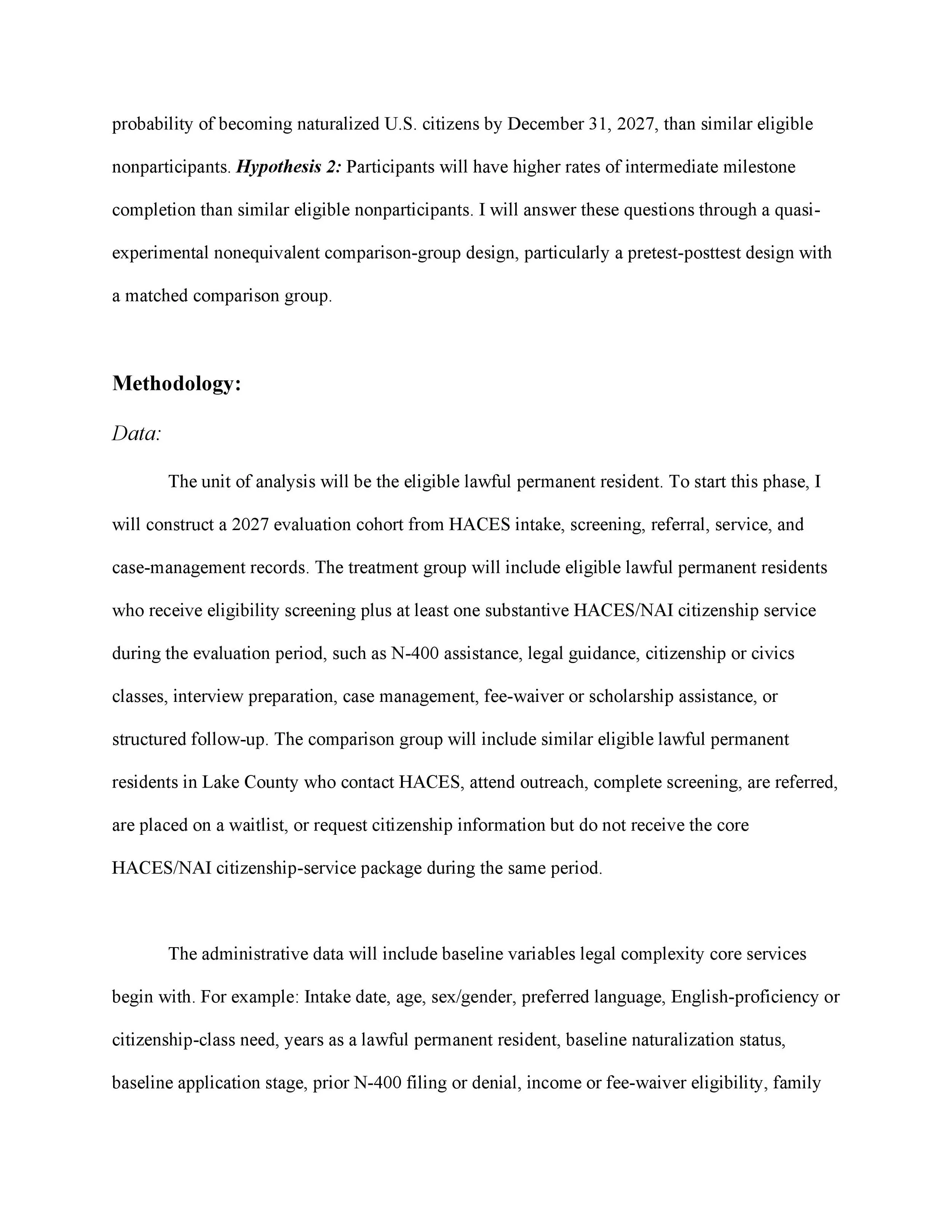
The proposed design was a quasi-experimental nonequivalent comparison-group design, specifically a pretest-posttest design with a matched comparison group. A randomized field experiment was rejected as inappropriate because HACES should not randomly deny or delay services to eligible lawful permanent residents seeking citizenship assistance. A non-experimental design was considered weaker because it would rely mostly on statistical controls without a carefully constructed comparison group.
Data & Measures
The unit of analysis was the eligible lawful permanent resident. The treatment group included eligible lawful permanent residents who received eligibility screening plus at least one substantive HACES/NAI citizenship service, such as N-400 assistance, legal guidance, citizenship classes, interview preparation, case management, fee-waiver or scholarship assistance, or structured follow-up. The comparison group included similar eligible lawful permanent residents in Lake County who contacted HACES or had some program contact but did not receive the core service package.
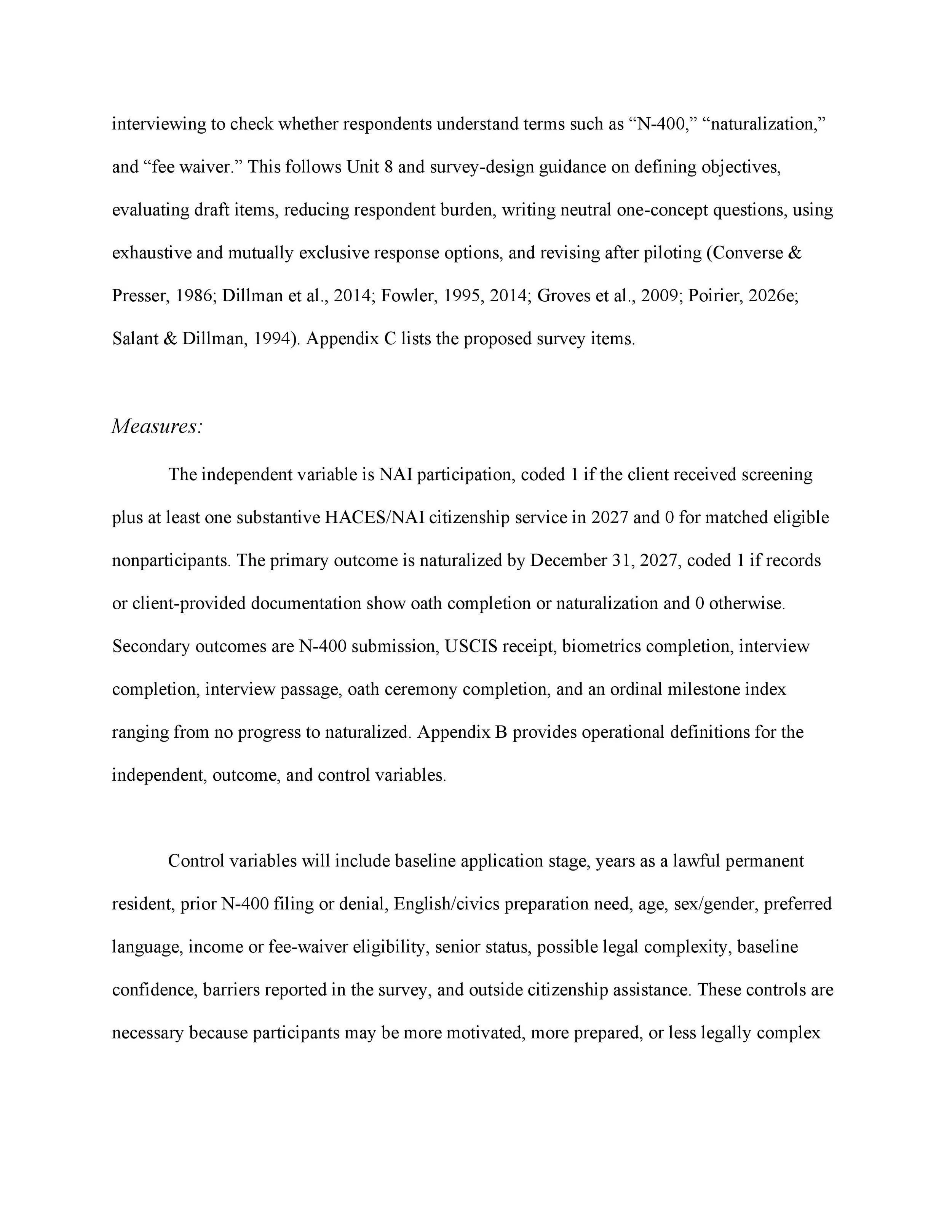
The primary outcome was whether a client was naturalized by December 31, 2027. Secondary outcomes included N-400 submission, USCIS receipt, biometrics completion, interview completion, interview passage, oath ceremony completion, and an ordinal milestone index.
Survey & Human Subjects Protections
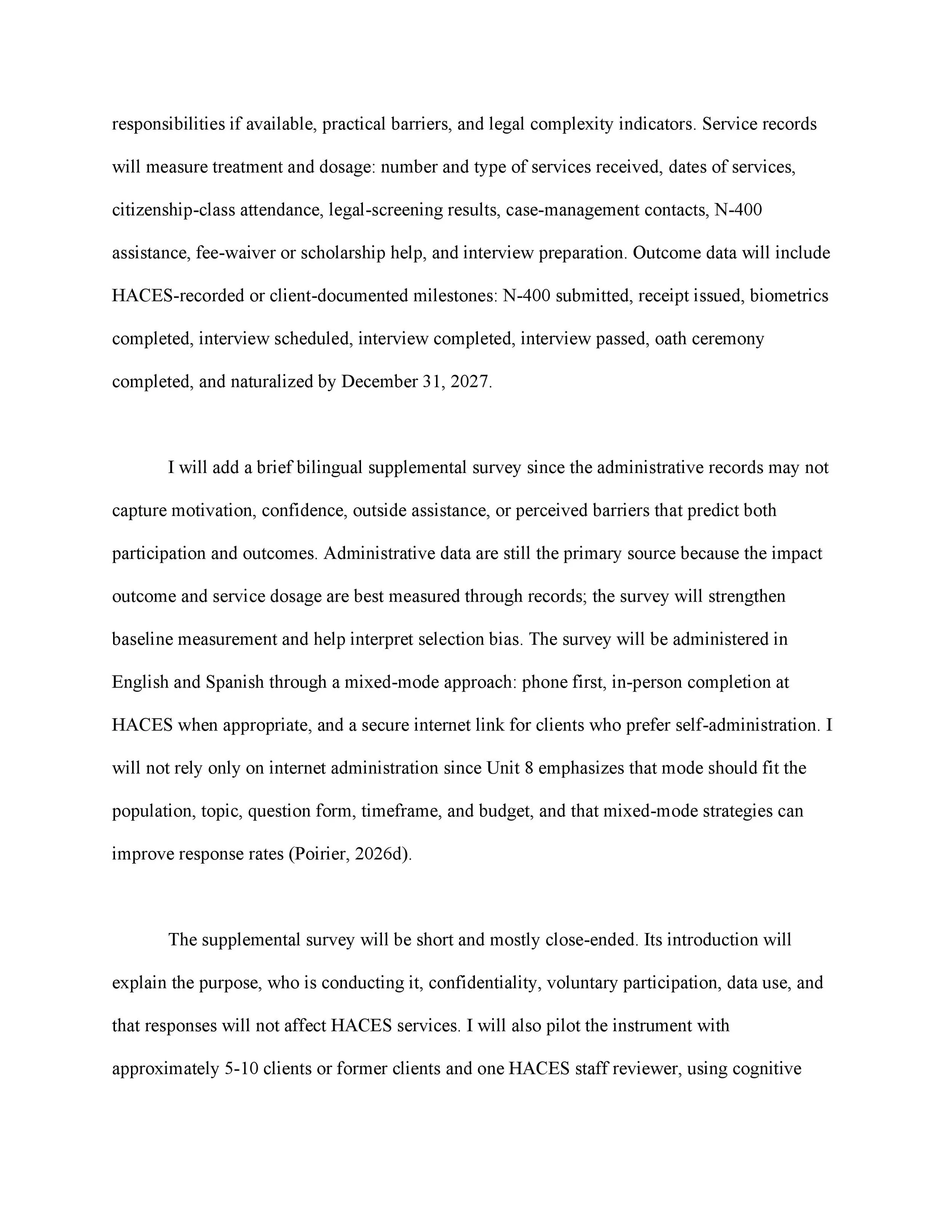
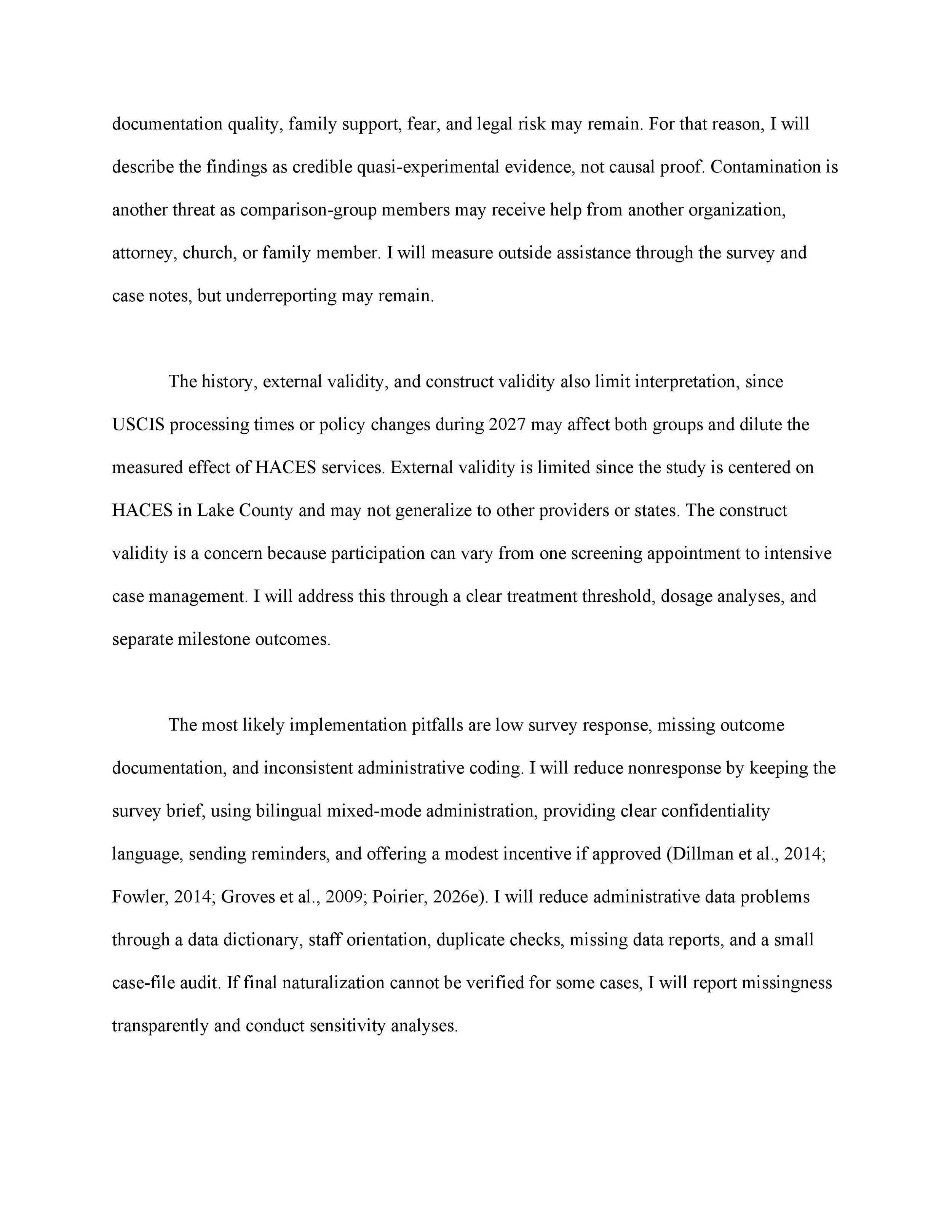
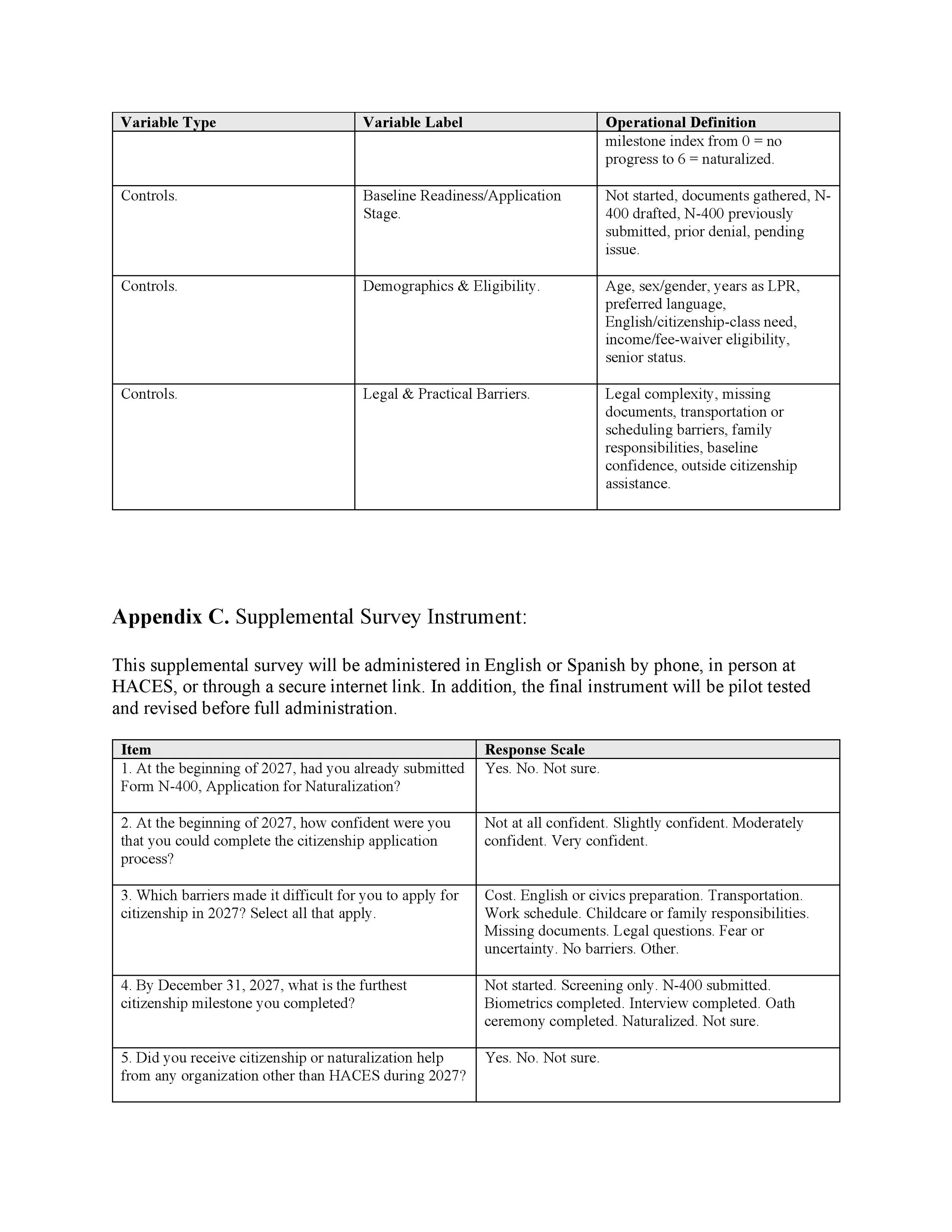
The design included a brief bilingual supplemental survey because administrative records may not capture motivation, confidence, outside assistance, or perceived barriers. The survey was designed for English and Spanish administration through phone, in-person completion at HACES, and secure online completion, with pilot testing before full administration.
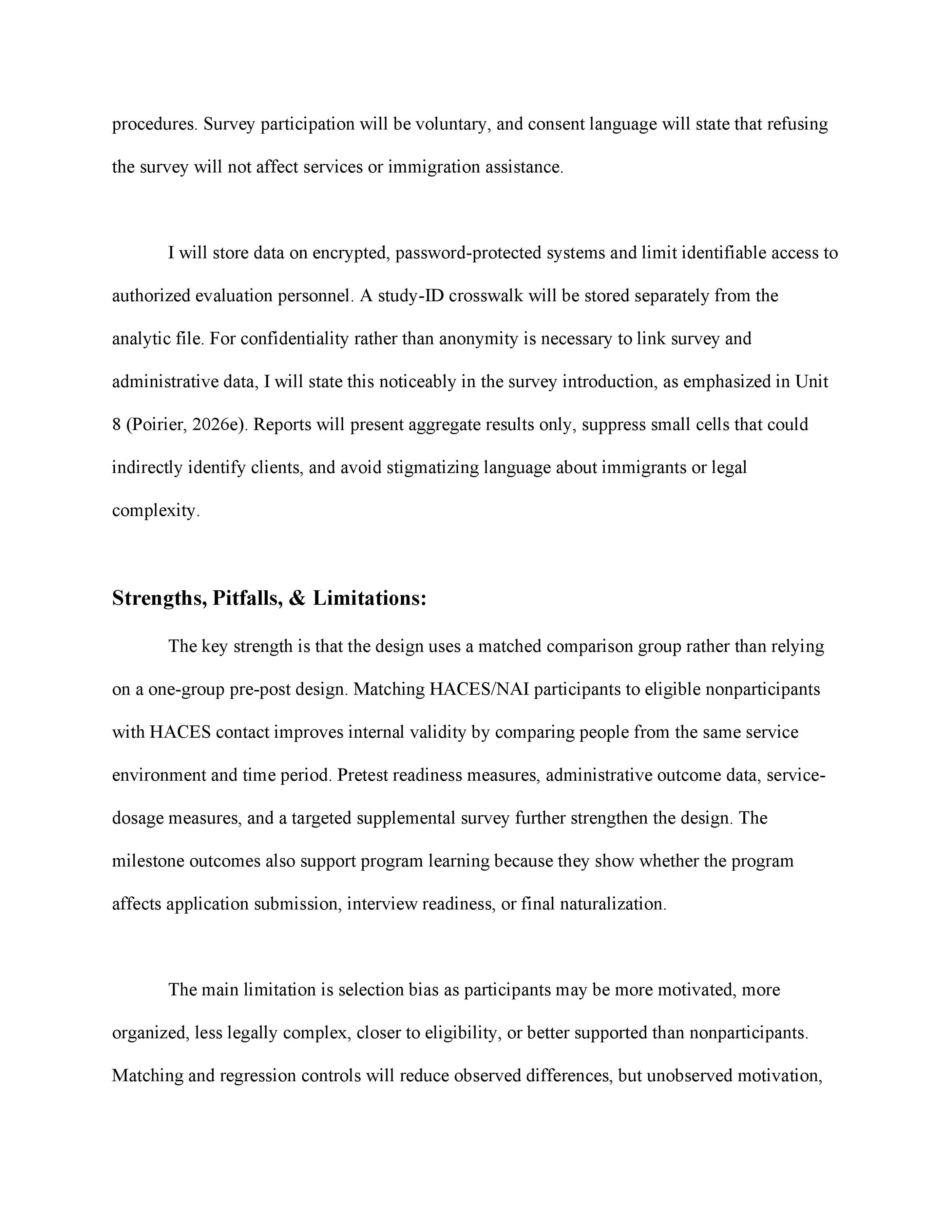
The proposal also addressed human-subjects protections because the evaluation would involve identifiable administrative and survey data about immigration status, legal-service participation, language needs, income or fee-waiver eligibility, and possible legal complexity. The plan included IRB review, a data-use agreement, encrypted storage, limited access, separate study-ID crosswalks, aggregate reporting, and suppression of small cells.
Analysis Plan
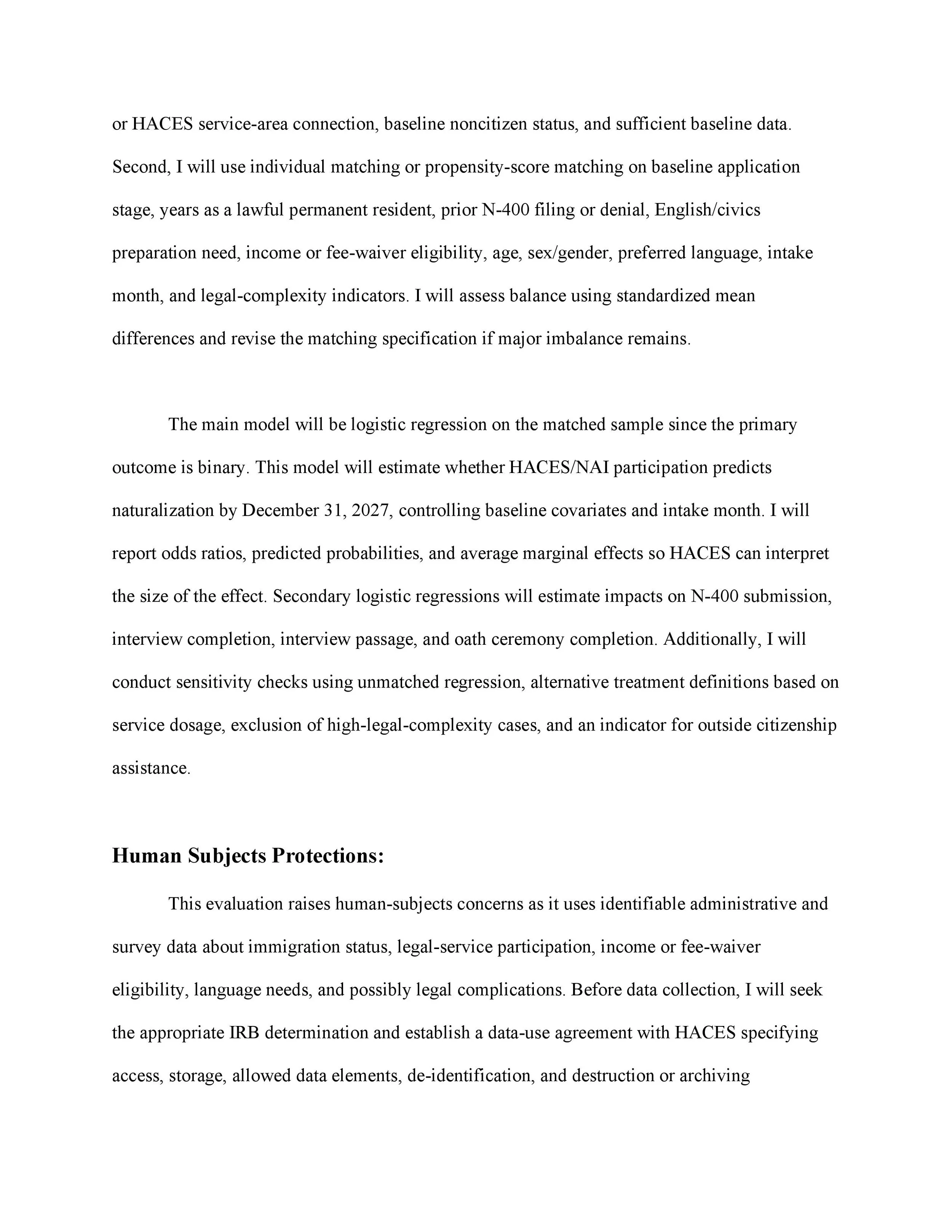
The proposal used individual matching or propensity-score matching to construct a comparison group based on baseline application stage, years as a lawful permanent resident, prior filing or denial, English/civics preparation need, income or fee-waiver eligibility, age, sex/gender, preferred language, intake month, and legal-complexity indicators. The main model was logistic regression on the matched sample, with results reported as odds ratios, predicted probabilities, and average marginal effects so HACES could interpret the effect size.
Why It Matters?
This project demonstrates the ability to design a credible evaluation for a real community-based program. It shows applied competence in program theory, logic modeling, impact evaluation design, matching, survey design, human-subjects protections, outcome measurement, and implementation-aware evaluation planning.
It is especially strong for your website because it connects your lived professional experience with HACES, your bilingual and immigrant-community work, and your graduate training in evidence-based program evaluation.
Professional Relevance
This work is relevant to nonprofit evaluation, immigrant-services programming, public administration, grant reporting, civic integration, policy analysis, and community-based research. It demonstrates the ability to design an evaluation that is rigorous enough for decision-making but practical enough for a real service organization to implement.
Key Demonstrated:
Impact evaluation design.
Program theory and logic modeling.
Quasi-experimental design.
Matched comparison groups.
Survey design.Human-subjects protections.
Logistic regression planning.
Evaluation reporting and dashboard design.
Personal Reflection:
This project reflects my graduate training in program evaluation and my commitment to designing practical, ethical, and evidence-based evaluations for programs that serve immigrant communities and advance civic participation.