Graduate Project Developed in Foundations of Policy Analysis, AU:
Disaster Preparedness Policy Analysis
Disaster Preparedness Policy Analysis
Overview
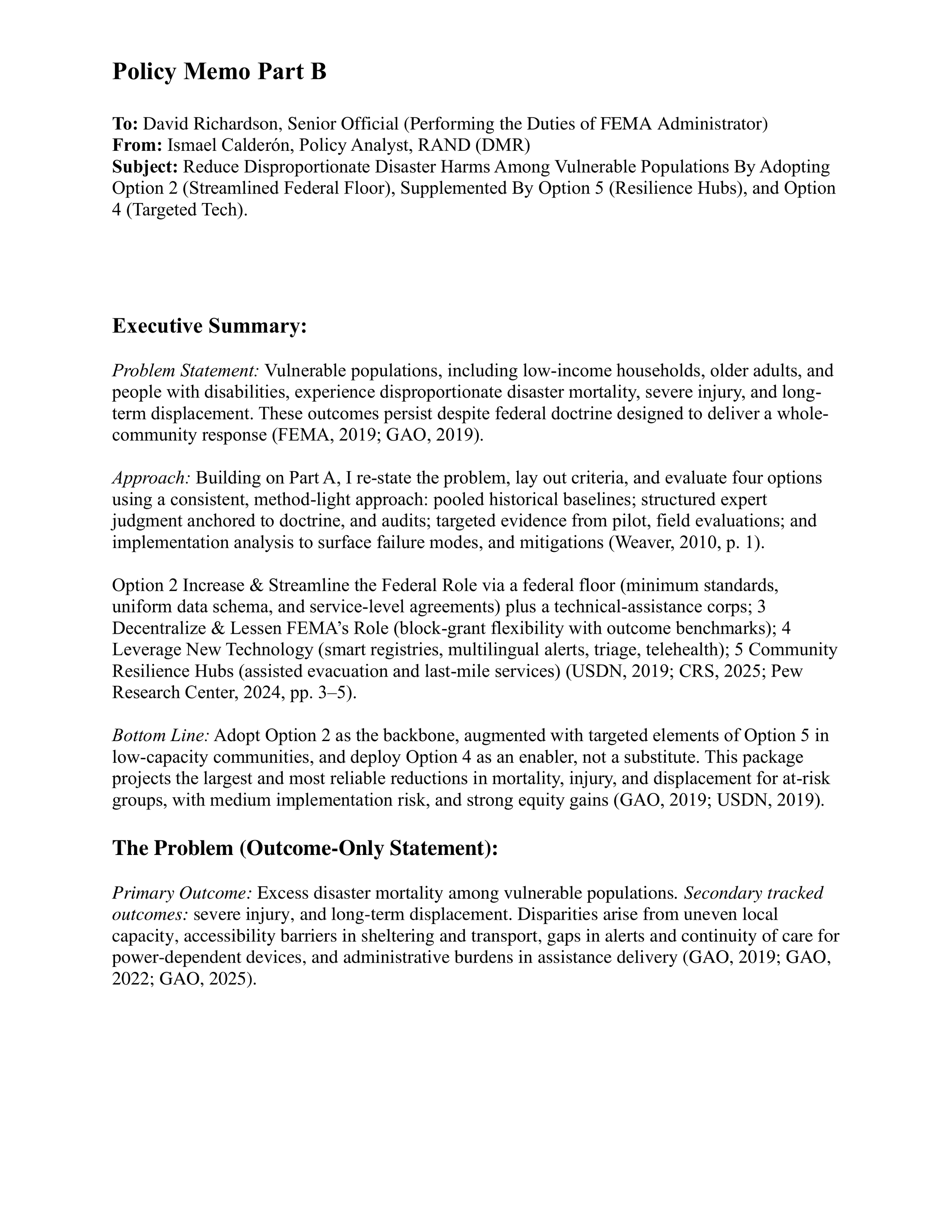
This project examined a central public-policy challenge: vulnerable populations—including low-income households, older adults, and people with disabilities—experience disproportionate disaster mortality, severe injury, and long-term displacement. The analysis focused on how policy design, implementation structure, and federal coordination can reduce preventable harms before and during disasters.
The Policy Challenge
The project framed disaster preparedness not only as an emergency-response issue but also as a policy-design problem shaped by uneven local capacity, accessibility barriers, fragmented data systems, continuity-of-care failures, and administrative burdens in the delivery of assistance. It kept the problem statement outcome-focused and centered on excess mortality as the primary outcome, while also tracking severe injury and long-term displacement.
What I Analyzed
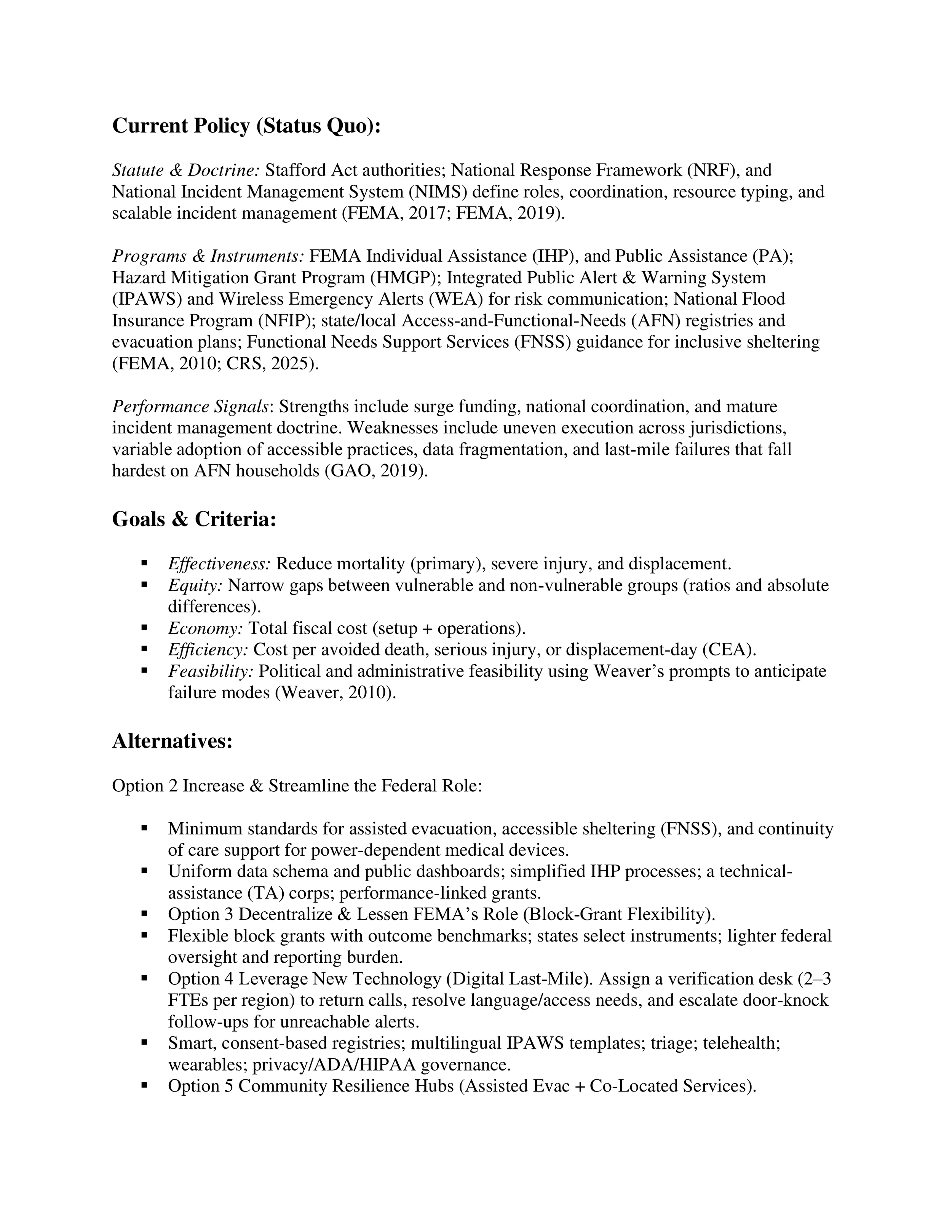
This project evaluated four policy alternatives:
Increasing and streamlining the federal role through a federal floor, minimum standards, uniform data schema, technical assistance, and performance-linked grants.
Decentralizing and lessening FEMA’s role through block-grant flexibility,
Leveraging technology through smart registries, multilingual alerts, and digital last-mile tools.
Developing community resilience hubs with assisted evacuation and co-located services.
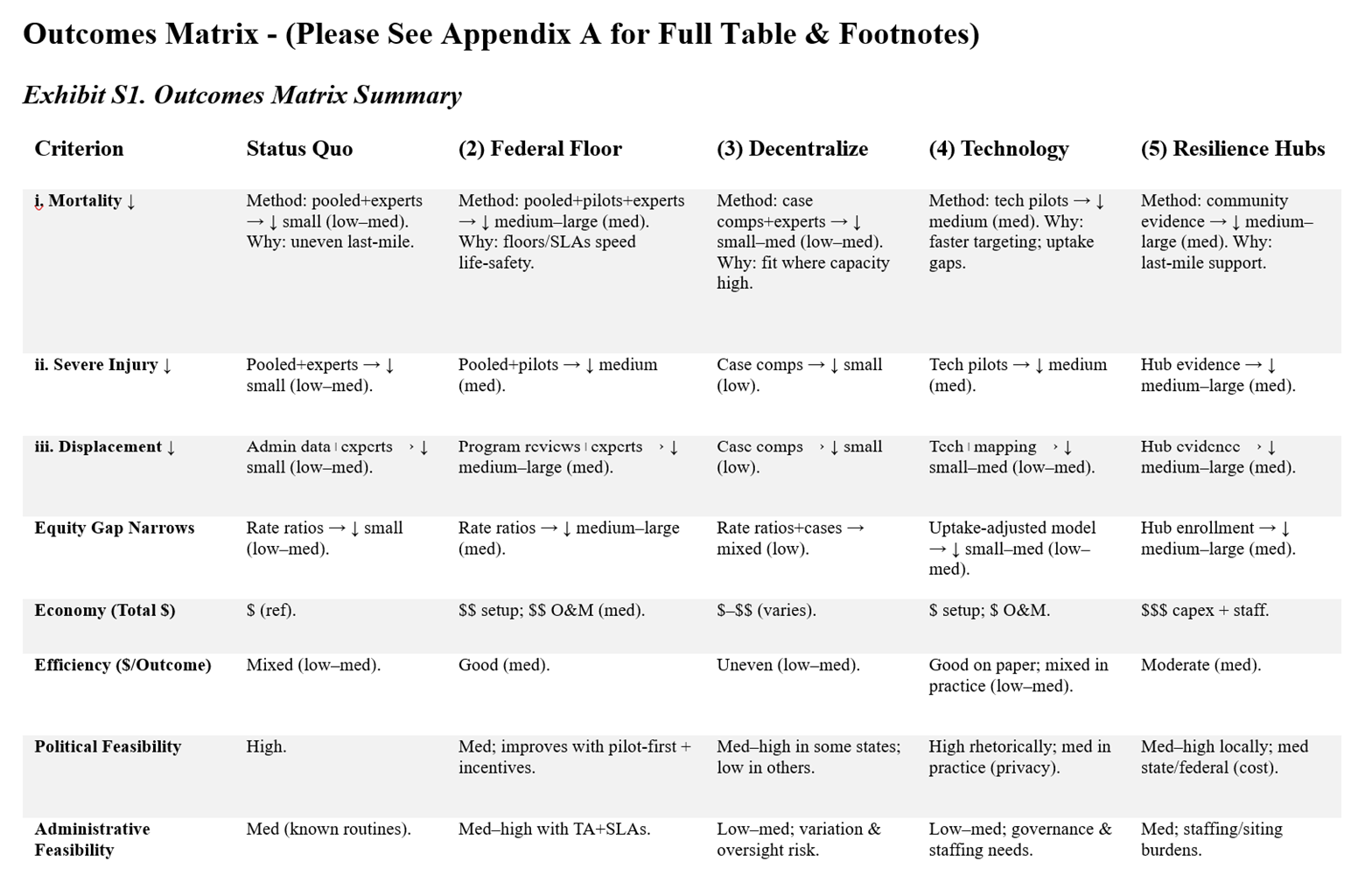
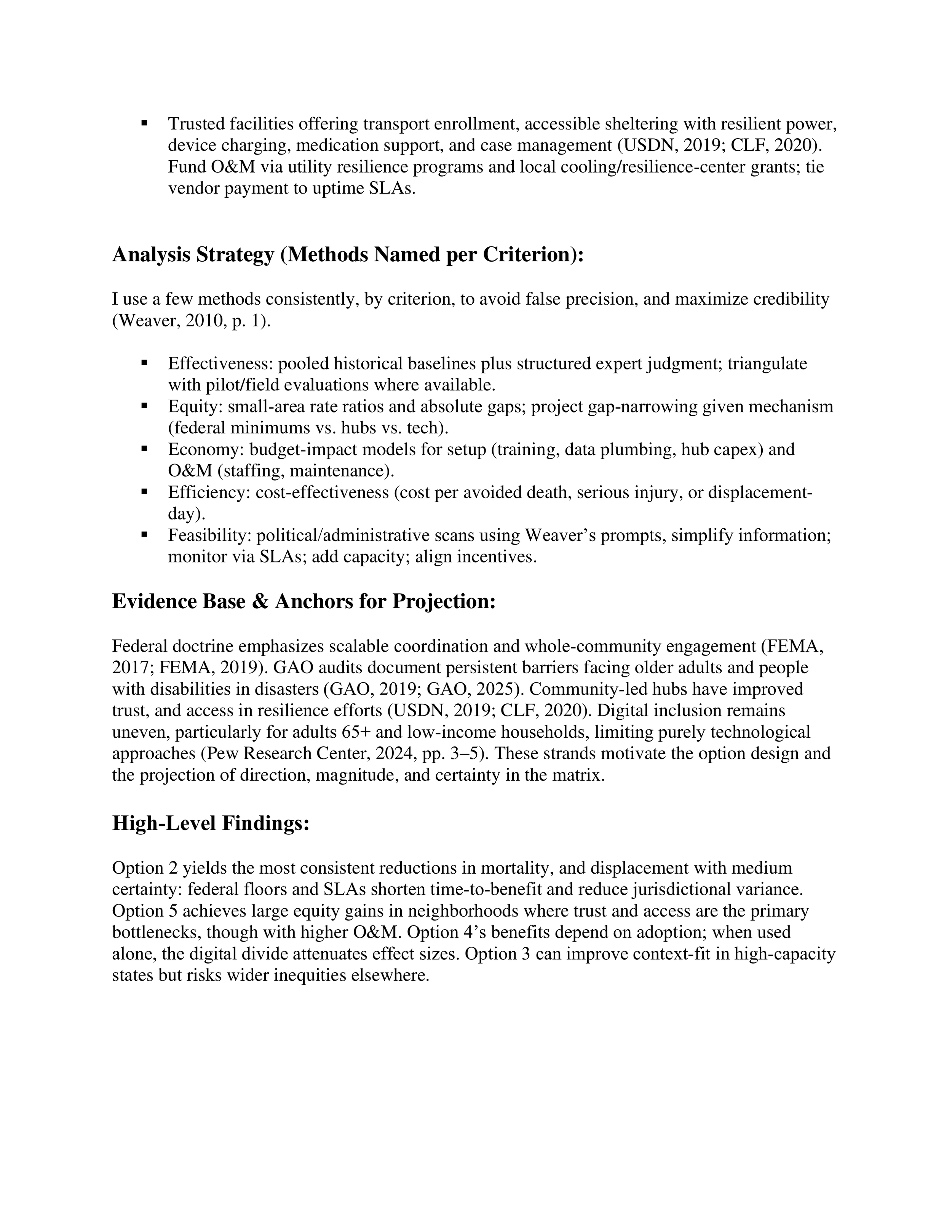
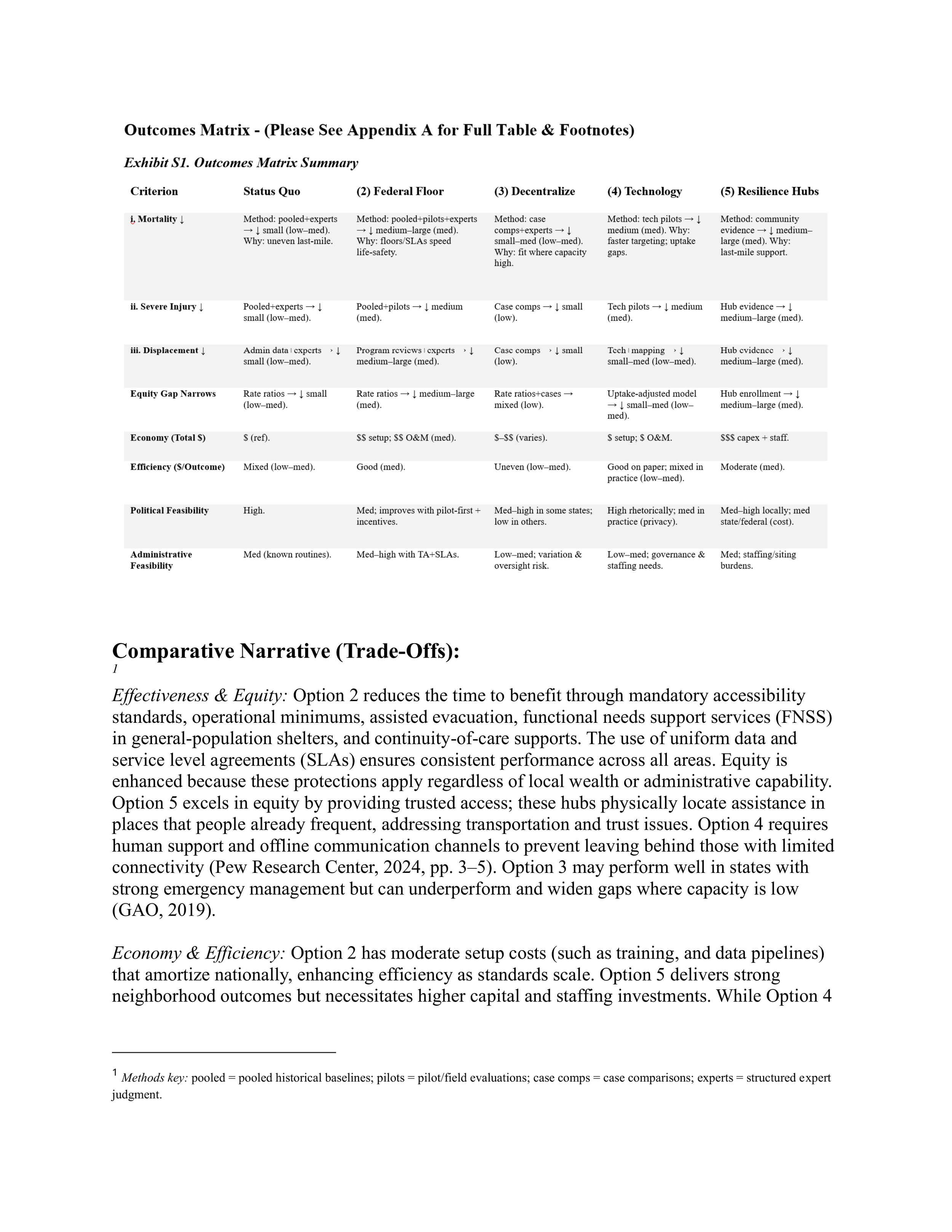
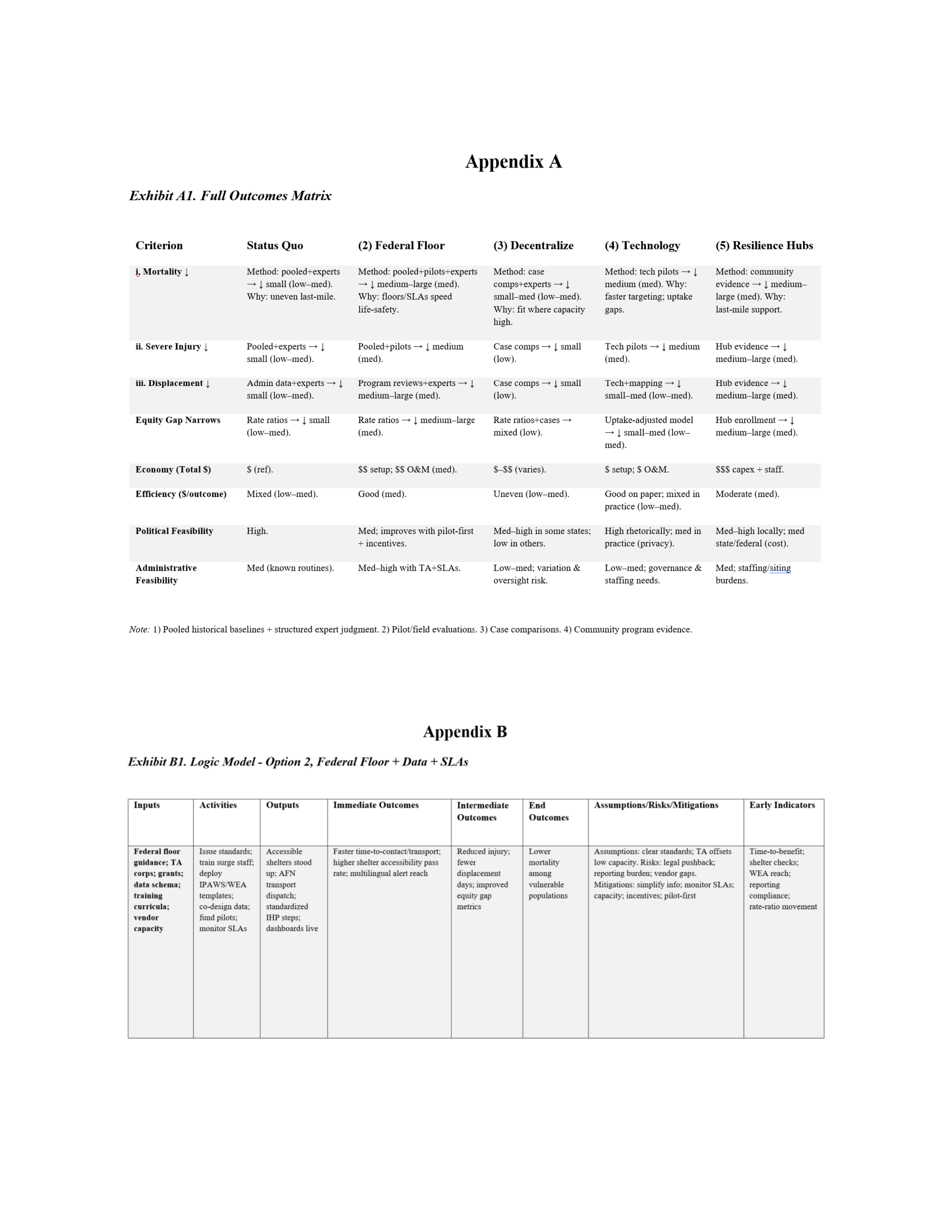
These options were compared using five core criteria: Effectiveness, equity, economy, efficiency, and feasibility. The analysis also used logic models, outcomes-matrix reasoning, and implementation prompts to surface risks, assumptions, and likely trade-offs.
Recommendation
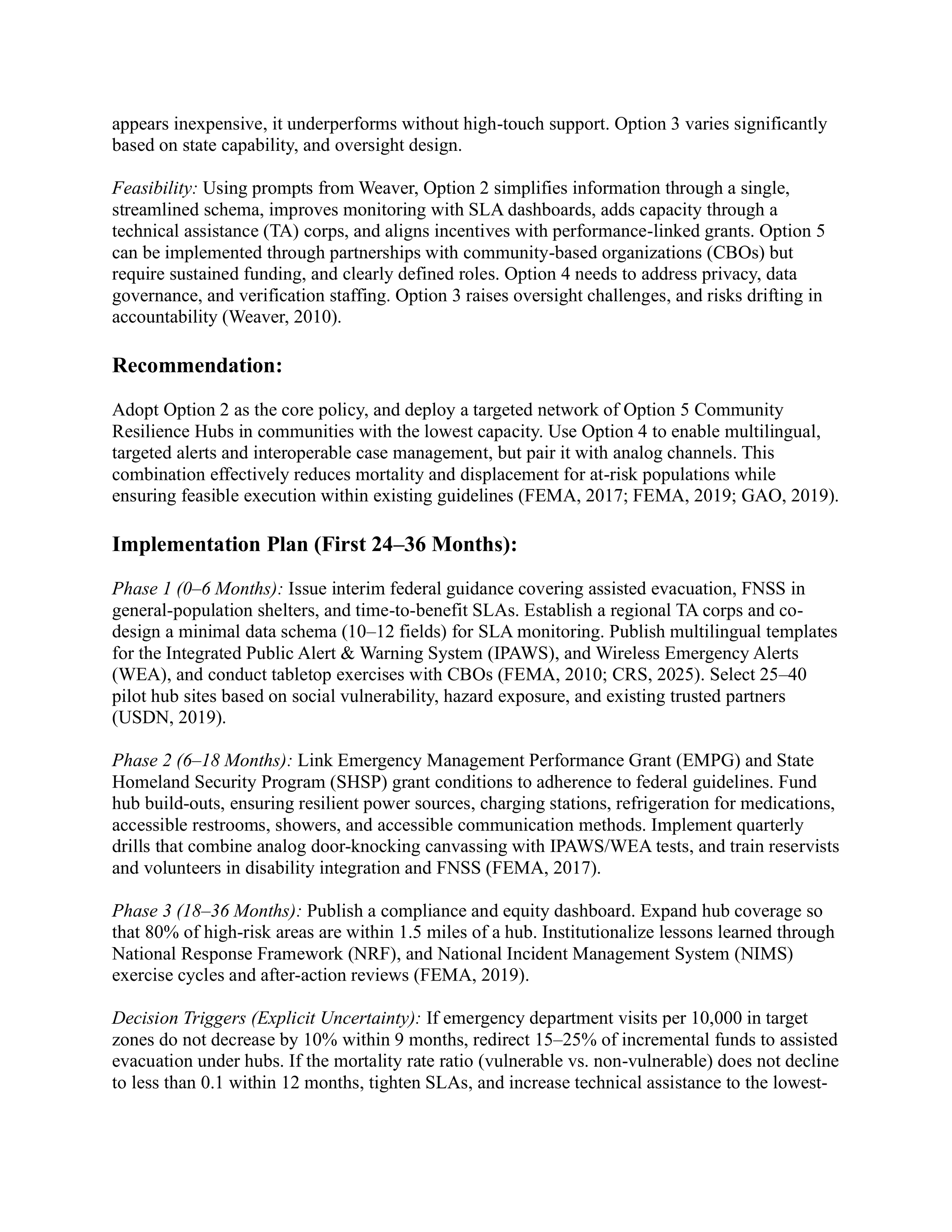
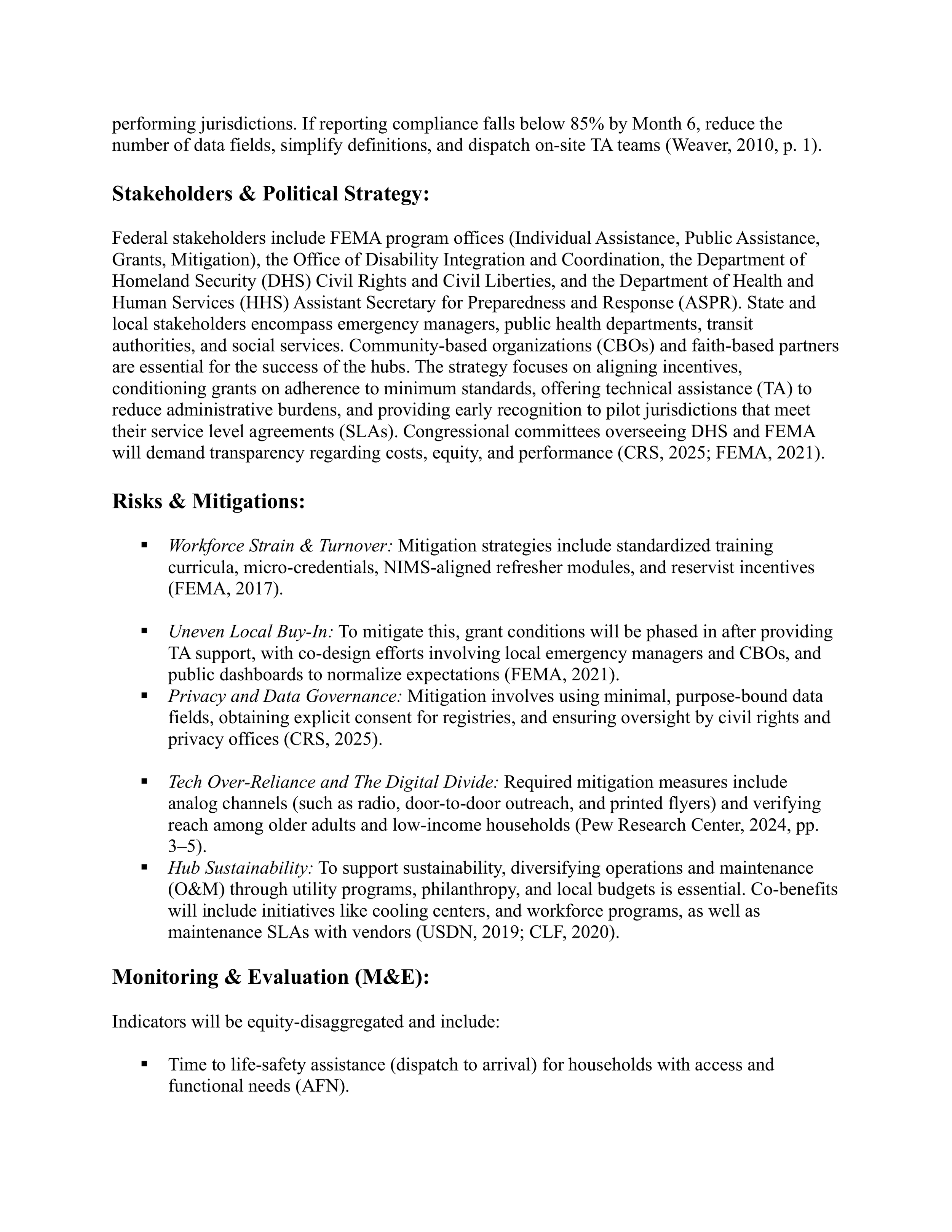
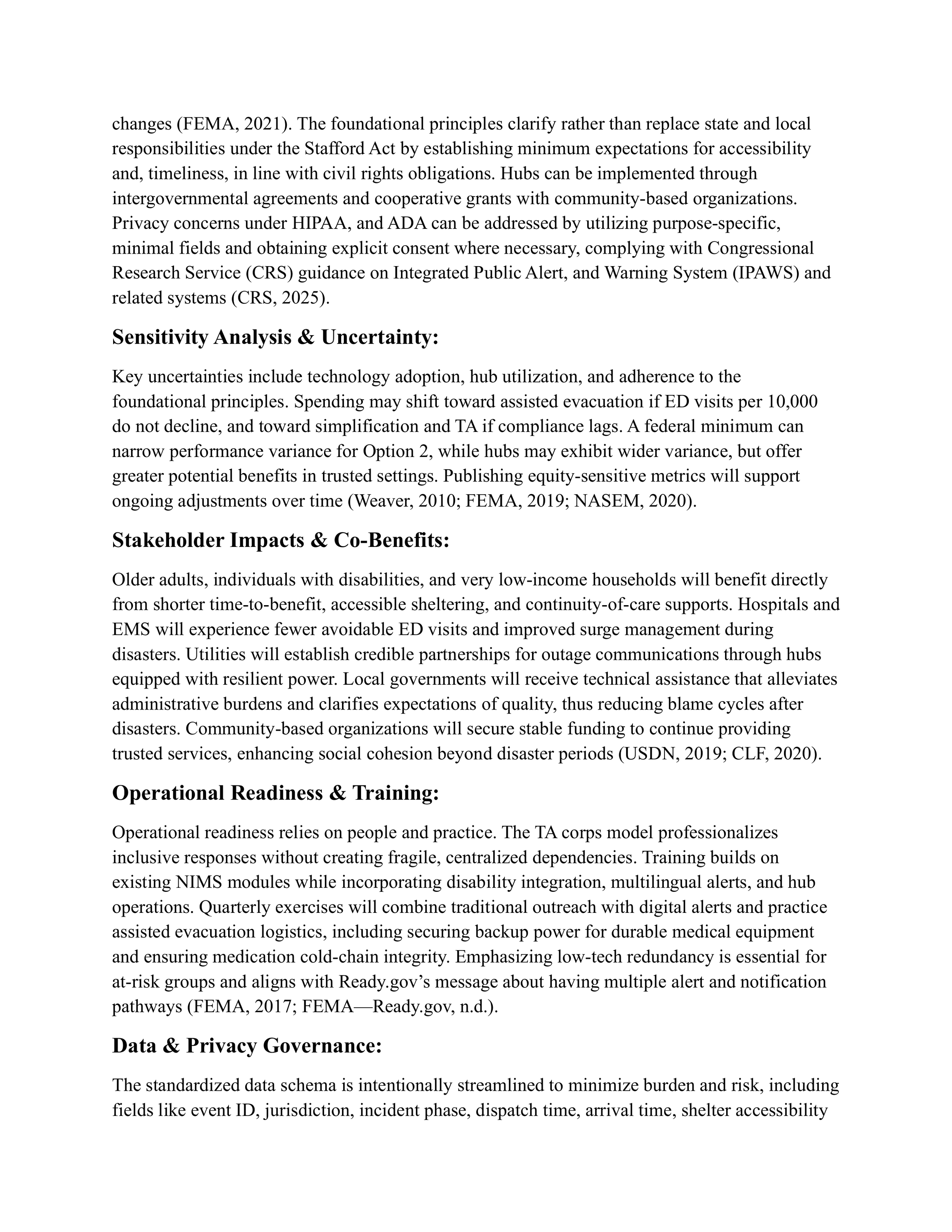
The final recommendation was to adopt Option 2 as the policy backbone, supplement it with Option 5 in low-capacity communities, and use Option 4 as an enabling tool rather than a substitute for institutional support. This package was judged to offer the strongest and most reliable reductions in mortality and displacement, along with meaningful equity gains and manageable implementation risk.
Why Does it Matter?
This project demonstrates the ability to translate a complex public problem into a structured decision framework. It reflects applied skills in policy framing, criteria-based analysis, implementation thinking, equity-centered evaluation, and recommendation development. It also shows a disciplined revision process: your reflection memo documents how you refined the problem statement, clarified the status quo, distinguished economy from efficiency, and used logic models and matrices as transparent reasoning tools rather than prediction devices.
Professional Relevance
This work mirrors the kind of analysis used in real policy settings: clearly defining a public problem, testing alternatives, identifying failure modes, anticipating implementation barriers, and making recommendations that balance effectiveness, equity, cost, and administrative reality. That makes it directly relevant to public policy, emergency management, social-impact strategy, and government-facing analytical work.
Skills Demonstrated
Policy analysis.
Problem definition.
Criteria-based evaluation.
Logic-model thinking.
Implementation analysis.
Equity-centered decision-making.
Recommendation development.
Professional policy writing.